
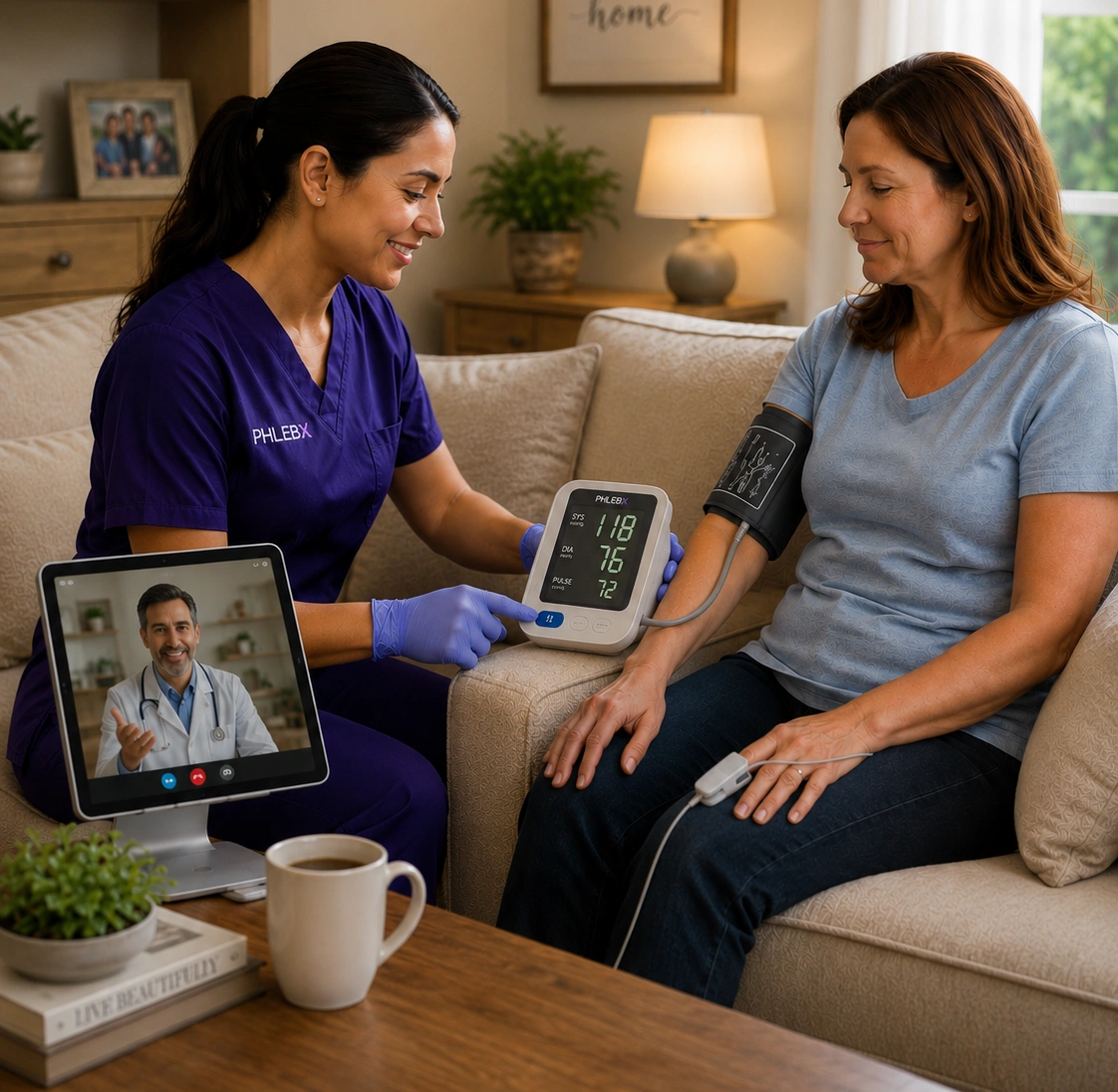
Virtual care is no longer just a video visit.
A recent American Medical Association article on virtual care’s role in enterprise strategy makes that clear. Health systems are beginning to treat virtual care as a broader operating model: one that can expand access, support clinician capacity, improve workforce flexibility, reach patients across larger geographies, and create more scalable ways to deliver care.
That is an important shift. But it also raises a practical question for every virtual care leader:
Can your program complete the next step when care requires something physical?
A virtual provider can identify that a patient needs labs. A care team can document the concern. A system can place the order. The patient can receive instructions.
But if care requires specimens, vitals, phlebotomy, ECG support, retinal imaging, spirometry, or hands-on diagnostic assistance, the program needs more than a screen.
It needs a physical layer.
What the AMA Article Signals
The AMA article points to several important themes for healthcare executives and virtual care leaders.
First, virtual care is becoming more structured. Health systems are consolidating programs, creating dedicated leadership, and looking for shared workflows, best practices, and operational efficiencies across the enterprise.
Second, virtual care is becoming part of workforce strategy. It can help extend clinician reach, support recruitment and retention, cover gaps in clinic capacity, and give experienced clinicians new ways to practice without building more physical locations.
Third, virtual care is expanding beyond urgent care or simple telehealth. Programs are moving into primary care, practice support, wellness, chronic care, behavioral health-adjacent support, and other models that require stronger clinical infrastructure.
Fourth, virtual care still has a last-mile problem. Even when most of the visit can happen remotely, there are moments when care still requires a physical action: a blood draw, specimen collection, vitals, diagnostic data, or hands-on support during a virtual encounter.
That is where many virtual care programs begin to show their limits.
Where the Physical Layer Breaks Down
The breakdown usually does not happen because the provider missed the need.
It happens because the system has no simple way to complete the need once it is identified.
Common breakdown points include:
Orders that are placed but not completed
A provider orders lab work, but the patient never makes it to the lab.
Patients who understand the instruction but cannot act on it
Transportation, mobility, work schedules, caregiving responsibilities, rural access, or health status can prevent follow-through.
Care teams that spend time chasing missing results
Staff are left calling, reminding, documenting, and escalating instead of moving care forward.
Virtual visits that create downstream diagnostic needs
The visit works, but the follow-through depends on a separate physical process.
Programs that identify care gaps but cannot close them
The gap is visible in the system, but the completion step remains outside the workflow.
Patients who need help during a virtual encounter
Some visits require vitals, specimens, or hands-on diagnostic assistance to support the provider’s assessment.
These are not technology problems alone. They are execution problems.
Virtual Care Leaders Need to Ask a Different Question
Many organizations have spent years asking:
Can we connect the patient to a provider virtually?
That question still matters, but enterprise virtual care now has to answer a more operational question:
Can we complete the next step after the virtual visit?
That is where the physical layer becomes strategic.
If a virtual care program can identify needs, document gaps, and place orders, but cannot help patients complete the diagnostic step, the model remains incomplete.
The strongest programs will be able to move from access to action:
The need was identified.
The service was ordered.
The diagnostic step was completed.
The information returned to the care team.
The provider had what they needed to make the next decision.
That is the difference between virtual access and completed care.
A Practical Self-Assessment for Virtual Care Leaders
Use the questions below to assess where your virtual care program may need an in-home diagnostic layer.
1. Diagnostic Completion
Can your virtual care team complete ordered lab work without sending every patient to a separate site of care?
Do you know where patients are dropping off after orders are placed?
Are incomplete labs delaying provider decisions?
Are care teams spending time chasing missing diagnostic information?
2. Patient Access and Barriers
Do your patients face transportation, mobility, rural access, work schedule, or caregiving barriers?
Are certain patient populations less likely to complete lab work or diagnostic follow-up?
Do you have a plan for patients who cannot easily travel to a lab?
Does your program support patients who need care completed in the home?
3. Virtual Visit Follow-Through
When a virtual provider identifies a need for labs, vitals, specimens, or diagnostic support, what happens next?
Is the next step coordinated inside the care workflow?
Can the patient complete the diagnostic requirement without navigating another disconnected process?
Does your team receive confirmation when the step is completed?
4. Workflow Integration
Can in-home diagnostic orders flow through existing LIS, EHR, or EMR workflows?
Does your team have visibility into scheduling, completion, and exceptions?
Are results and documentation routed back to the right clinical stakeholders?
Is the process easy for providers and care teams to understand?
5. Compliance and Quality
Are field teams trained for patient identification, specimen handling, documentation, and privacy requirements?
Is there a clear process for escalation if something changes in the home?
Are chain-of-custody and quality controls defined?
Is the model aligned with your organization’s compliance expectations?
6. Scalability
Could your current model support additional markets, service lines, or patient populations?
Would expansion require hiring and managing your own field team?
Can you test the model through a defined pilot before scaling?
Do you have a partner who can support both operational execution and clinical workflow alignment?
What the Answers Reveal
If your program can identify needs but struggles to complete the physical next step, you do not have a virtual care problem. You have a missing physical layer.
That layer matters because virtual care is no longer just about access to a provider. It is about creating a more complete care model that can move from identification to action.
The AMA article makes an important point: virtual care is becoming part of enterprise strategy. But enterprise virtual care cannot stop at the screen. It has to account for the clinical moments when patients still need specimens collected, vitals captured, diagnostic data gathered, or hands-on support in the home.
How PhlebX Supports the Physical Layer of Virtual Care
PhlebX helps clinical partners bring diagnostic services into the home through compliant, digitally coordinated field teams.
We support mobile phlebotomy, specimen collection, vitals capture, telepresenter support, diagnostic data capture, and future point-of-care capabilities such as ECGs, retinal imaging, bone density testing, spirometry, and other diagnostics depending on partner needs and equipment structure.
We do not replace the care team. We extend it.
PhlebX works inside existing provider relationships, workflows, contracts, and clinical infrastructure to help complete the diagnostic actions that cannot happen through a screen alone.
For virtual care leaders, the opportunity is not to build every piece of field infrastructure internally. The opportunity is to evaluate where the current model breaks down and test an in-home diagnostic layer that helps complete the next step.
Because when care requires something physical, virtual care needs a trusted way to reach the home.
Ready to assess where your virtual care program needs a physical layer? Contact us today.